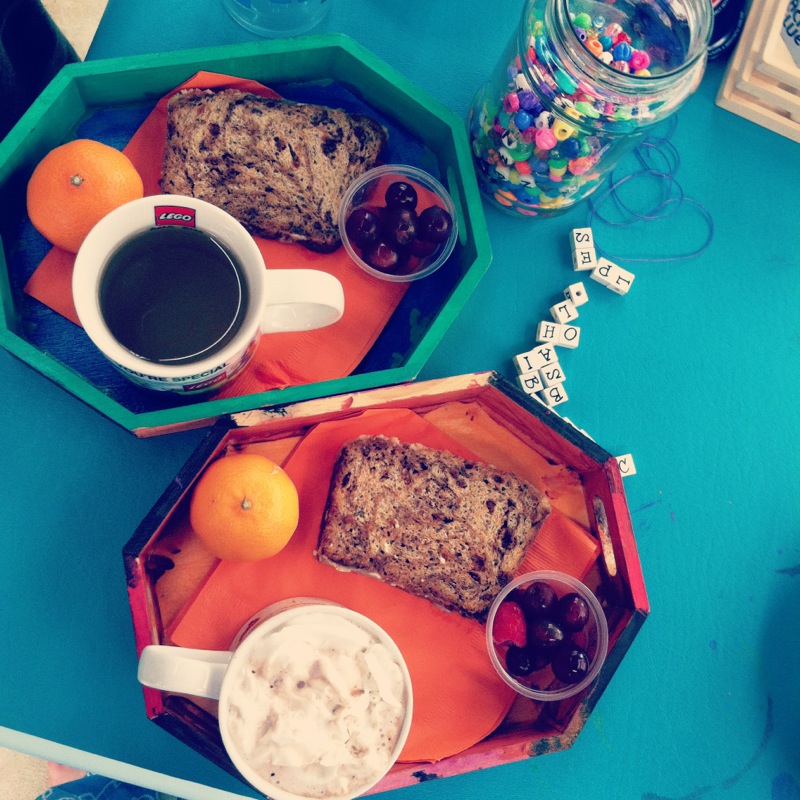
I was killing time today just before VBS pickup when I decided to go into a very fancy grocery store. After wandering for a while, I chose some kale. Everyone and their mother seems to be making kale chips these days; I thought I'd give it a try (ie. trick my kids into eating a new vegetable by calling them chips). While paying, I wondered if the check-out girl had also made these chips. The odds were in my favor, so I asked if she had any advice. Sure enough, she was a kale chip expert. But almost immediately, I realized her advice was useless. First she said something about using a food dehydrator. Which lost me. I have a hard enough time keeping my kids, myself, my pets and my vegetable garden hydrated. I don't need anything in my life that actually encourages dehydration. So when she mentioned mixing the chips with some substance called miso paste, I was already not listening. Not that I even know to which food group miso paste belongs.
Moving on. The kale chips turned out good. One of my two kids sort of mostly liked them, after salting them to the point of erasing any health benefit the vegetable could have had. But I'm not bothered by that, tonight, nearly as much as I've been bothered - no, haunted - by Kristen's posts this week over at Rage Against the Minivan.
Kristen has been in Ethiopia with Food for the Hungry Bloggers. She's been sharing stories of children and families who don't have enough food. They don't have enough anything. It's caused me to think about food all week, and more importantly, my feelings about food, my casual indulgence, my sense of entitlement when it comes to food, and my habitual ingratitude.
The thing is that I've tried to assimilate the information about the state of affairs of these Ethiopian families and shape it into a productive act of mercy on my part. Of course, the whole objective is that the reader's heart is moved to the point of helping. Tangibly. Not just spectating, or experiencing a warm swell of compassion, but becoming invested and engaged.
But I'm good at math, and as a family, we don't have any extra to give. I say that with uncertainty. I say that feeling a little sick, knowing I'm surrounded by excess and wealth, relatively, simply because I have a home, a car, and 5,000 other things that those families do not have. And yet, my husband and I narrowly escaped an argument tonight over the question of how exactly his decent income so quickly disappears every month. The math doesn't lie, but I also understand I live in a paradigm and a culture of self-indulgence and material accumulation. I spent my evening trying to perfectly toast a kale chip and wanting to complain on Instagram about how much laundry I have to do. Never once did I feel grateful for that laundry, or consider giving half of it away to someone who really needs clothing.
We are so downright quick to meet our own needs out of our abundance, we forget most of the world doesn't - can't - live that way.
I'm simply having a hard time wrapping my mind around this: I live in utter luxury compared to the families in Ethiopia. And yet compared to many families around me in Orange County, CA, we live in scarcity. I'm bothered by the paradox. I'm bothered by not knowing exactly how to change things. I'm bothered by not having "room" to be generous to the poor. Something's wrong, and God help us if we don't try to make it right. God help us if we, His children, don't work this out on a very personal level.
Some people see socioeconomic disparities in the world as injustice, and sometimes they even blame God for it. The truth is that we live in an unjust world. It's broken, and sin rules it with an iron fist. It wasn't God's plan A, but it is all part of his permissive will. He's allowing injustice for reasons we don't dare guess (or question). However, one thing of which I'm certain is that God himself is perfectly just. And therefore, we will all be judged for how we treated the poor. We will all be asked how we managed our resources. And God probably isn't going to be calling us into account by county.
I might be in line ahead of a mother from Ethiopia. When it's my turn to answer how I spent my money, I just have a feeling the "we didn't have room" argument isn't going to stand.
{look at the faces of the hungry here,
even see how long each child has been waiting
for a sponsor if you click on his or her photo.}
even see how long each child has been waiting
for a sponsor if you click on his or her photo.}